The Alta Via 1 starts at one of the most photographed lakes in the world and ends in Belluno. Almost nobody, though, actually stops in Belluno. Hikers come down from the mountain, catch a bus, look for a train or a coach to the airport, and the town remains a name on a bus stop sign. That is a shame: the last stage is the wildest of the whole route, and the town at the end of it is the place where the Alta Via was dreamed up.
This guide is for anyone planning the trek for next summer who wants to know how it really ends: the two possible descents, how to reach town from La Pissa or Case Bortot, why you should not book your flight for the day you finish, and what to do with the extra evening and morning that are worth keeping.
Where exactly does the Alta Via 1 end?
On paper the Alta Via delle Dolomiti n. 1 runs from Lago di Braies to Belluno: about 120 kilometres, around ten stages in the classic version, seven or eight for fast walkers. In practice, after Rifugio Pian de Fontana the route splits in two, and your choice changes both the difficulty and the point where you reach the valley.
The original finish: the Schiara and Rifugio 7° Alpini
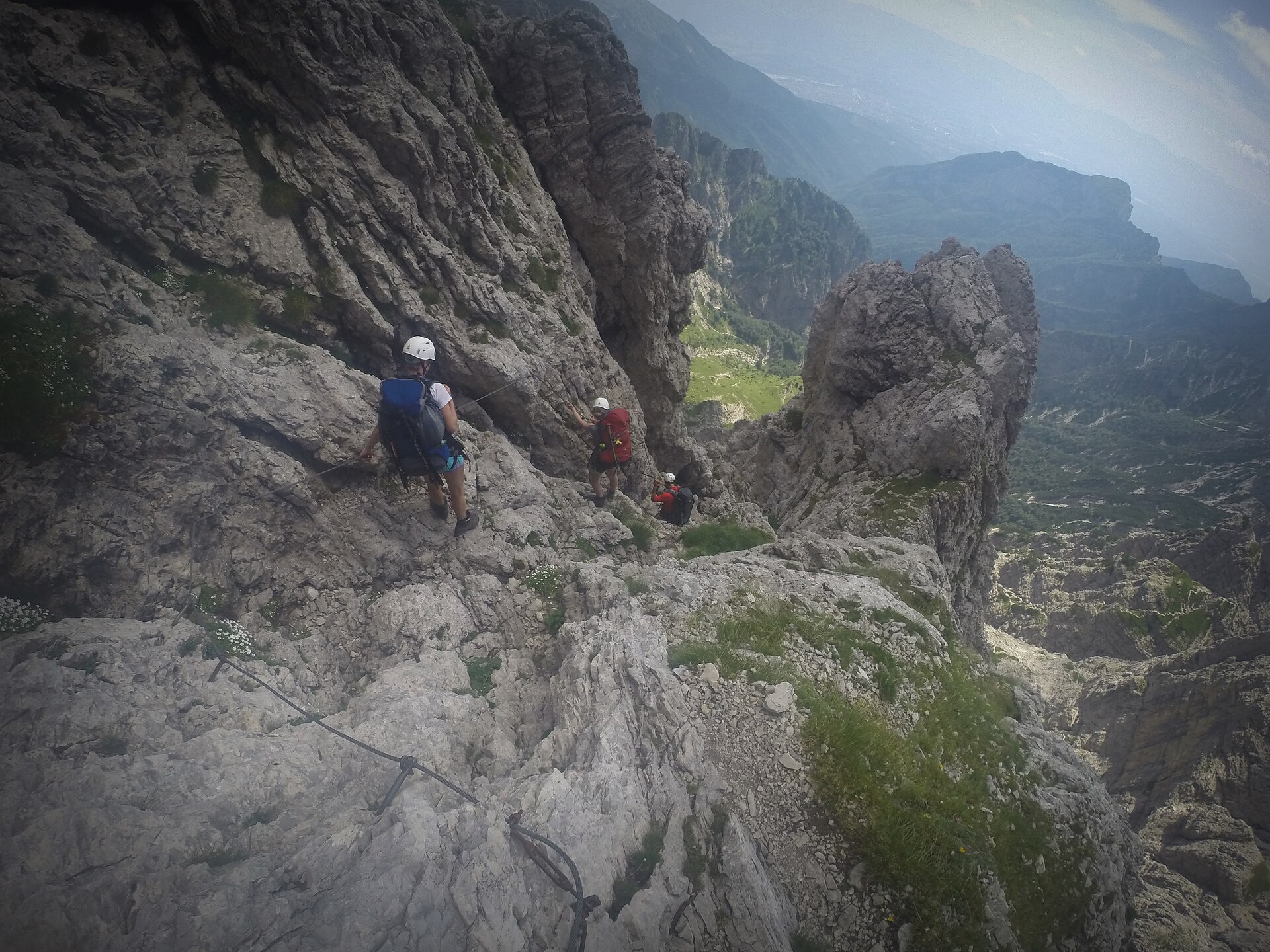
This is the ending the creators of the Alta Via had in mind. You climb to the Bivacco del Màrmol and descend the south face of the Schiara on the Piero Rossi via ferrata, known for years as the Marmol via ferrata and today the most travelled final section of the route. It brings you to Rifugio 7° Alpini, at 1,502 metres in the Pis Pilon basin: the Italian Alpine Club describes it as the usual final stage of the Alta Via 1.
What remains is the Ardo valley and the hamlet of Case Bortot, above town: from the hut to Belluno it is about 12.7 kilometres and four and a half hours downhill, almost entirely through forest along the stream. Few other European treks end like this: you step off the rock and, half a day later, you are walking on the paving stones of a town.
Important: the via ferrata is graded EEA, for experienced hikers with equipment. You need a harness, a via ferrata set, a helmet and experience. If you have never done a via ferrata, this is not the place to learn, at the end of a week on the trail, with tired legs and a full pack.
The hiking finish: Rifugio Bianchet and La Pissa
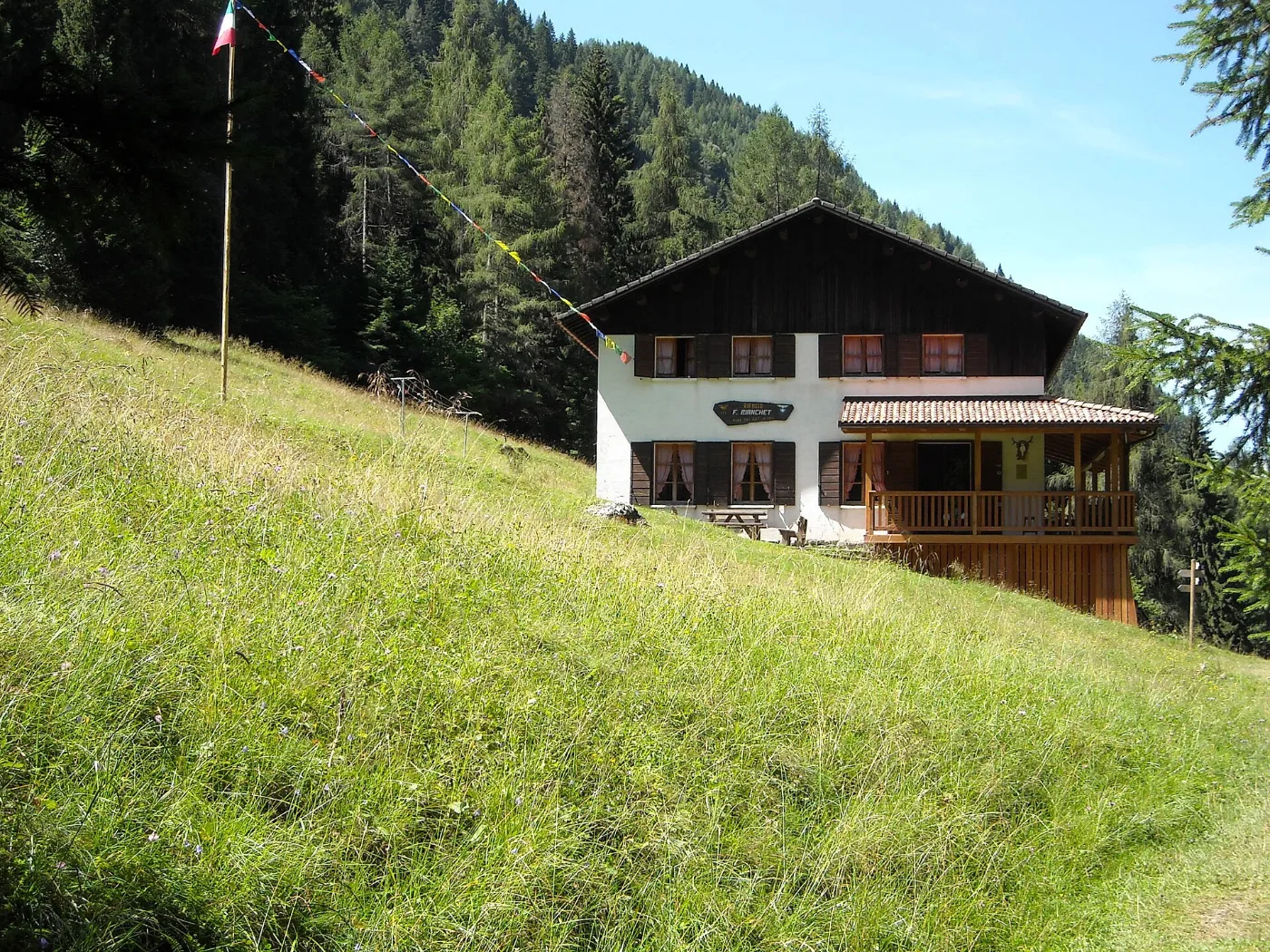
This is the variant most international hikers choose today, and the one offered by almost every trekking company. From Pian de Fontana you descend to Rifugio Furio Bianchet, at 1,250 metres in the Vescovà valley, run by the Belluno section of the Italian Alpine Club. From there the trail continues through the woods to La Pissa, a bus stop on the Agordina regional road, at about 450 metres, in the municipality of Sedico.
No protected sections, but plenty of descent: from the Bianchet to La Pissa you drop about eight hundred metres, roughly two hours on foot. If you sleep at the Bianchet you reach the valley in the late morning, which is the best time to catch the bus.
From La Pissa to Belluno by bus
La Pissa is served by Dolomiti Bus line 1, which links Agordo to Belluno railway station. In just under half an hour you are in town. Three practical tips, worth more than any printed timetable:
- Check the timetable before you leave the hut, on the Dolomiti Bus website or with a maps app. Weekday and holiday timetables differ, and the service changes between summer and autumn.
- Do not count on Sundays. On the winter timetable Sunday buses may not run at all: if you finish on a Sunday, have a backup plan or an extra day.
- Sort out your ticket in advance, on the Dolomiti Bus website or at a ticket outlet. There is no ticket office at La Pissa: just a shelter, a road and the sound of the Cordevole river.
If you come down via Case Bortot you are already above town: for the last stretch, arrange a lift or a taxi, or keep walking.
Why you should not book your flight for the day you finish
It is the advice everyone who has finished the Alta Via repeats, and there are three concrete reasons. The first is weather: a storm on the Schiara or a wet trail can cost you half a day. The second is transport: valley buses with few runs, trains that in 2026 were replaced by buses on some lines, and tight connections with coaches to Venice airport. The third is the simplest: after a week of mountain huts, a night in a real bed and dinner in a town square are part of the trip, not a delay.
An evening and a morning in Belluno

Belluno is a small town you can explore entirely on foot, built on a terrace above the point where the Ardo flows into the Piave. It has one advantage that anyone coming down from the Alta Via notices at once: you can see the Schiara from almost every square, and with a little attention also the Gusela del Vescovà, the slender spire you have just walked around from above. You look back and see the whole of your last day.
What to see in a few hours
- Piazza dei Martiri, which locals still call the Liston: the town’s living room, the place for the evening stroll and an aperitivo.
- Piazza Duomo, with the Palazzo dei Rettori, the Cathedral of San Martino and the bell tower designed by Filippo Juvarra, visible from the whole valley.
- Palazzo Fulcis, home of the Civic Museum, with works by Sebastiano and Marco Ricci and by the sculptor Andrea Brustolon.
- Piazza delle Erbe and Porta Dojona, the oldest part of town, with arcades, fountains and frescoed houses.
What to eat
After a week of pasta and strudel in the huts, valley cooking is a change of key. The dish to try is schiz with polenta, a fresh dairy cheese cooked in butter; the other is pastìn, freshly made salami mix cooked on the griddle. With a glass of wine and the Schiara turning pink above the rooftops, it is the right way to end.
The town where the Alta Via was born

There is a reason the Alta Via 1 ends right here. The idea came from mountaineers from Belluno: Piero Rossi, Mario Brovelli and Giovanni Angelini, together with the Bavarian journalist Toni Hiebeler. In 1966 the German magazine Alpinismus, printed in Munich, presented the route to German-speaking hikers, and on 5 July that year two Bavarians, Gerda Hoffmann and Ulrich Görn, became the first to complete it. One passage was missing to cross the Schiara: the Belluno section of the Italian Alpine Club built it.
Piero Rossi published the first guidebook in 1969, and the via ferrata that now bears his name is the very one that closes the route. The hut where it ends, Rifugio 7° Alpini, was built in 1950–51 by the Belluno Alpine Club together with the National Alpini Association, with decisive help from the army, and dedicated to the fallen of the 7th Alpini Regiment, once stationed in Belluno. Next to it, since 1952, stands the chapel of the Regina Alpinorum. Coming down from the Schiara, you walk straight into the town’s history without knowing it. Read more in our guide to Rifugio 7° Alpini and the story of its name.
Frequently asked questions
Does the Alta Via 1 end at La Pissa or in Belluno?
In Belluno. La Pissa is the bus stop at the end of the hiking variant, without via ferrata, that passes Rifugio Bianchet. The original finish descends from the Schiara to Rifugio 7° Alpini and then to Case Bortot, above town.
Do I need via ferrata gear?
Only for the Schiara finish on the Piero Rossi via ferrata: harness, via ferrata set and helmet are mandatory, and it is a section for experienced hikers. The Bianchet and La Pissa variant has no protected sections.
How long does it take from La Pissa to Belluno?
Just under half an hour to the railway station on Dolomiti Bus line 1. Timetables change between weekdays and holidays and between summer and winter: check them on the day.
Is it worth spending a night in Belluno?
Yes, for two reasons: it lowers the risk of missing your flight because of a delay on the trail or on public transport, and it lets you see the town you have been looking down on from the Schiara all through your last day.
Keep exploring
- Alta Via n. 1: from Lake Braies to Belluno
- The Alta Via trails of the Dolomites: which one to walk
- Rifugio 7° Alpini: the hike from Case Bortot
- The legends of the Gusela del Vescovà
- Belluno Dolomites: 15 places to see at least once
Cover image: first light on the Schiara, the mountain that closes the Alta Via 1 above Belluno. Photo: Ciro Bassi, Wikimedia Commons, CC BY-SA 4.0.